Stop allocating budget based on revenue that is claimed twice.
Meta can be right. Google can be right too. But your store still has one order. Layer Insights reconciles touchpoints, orders and spend so you can see which channel contribution survives when all claims are combined.
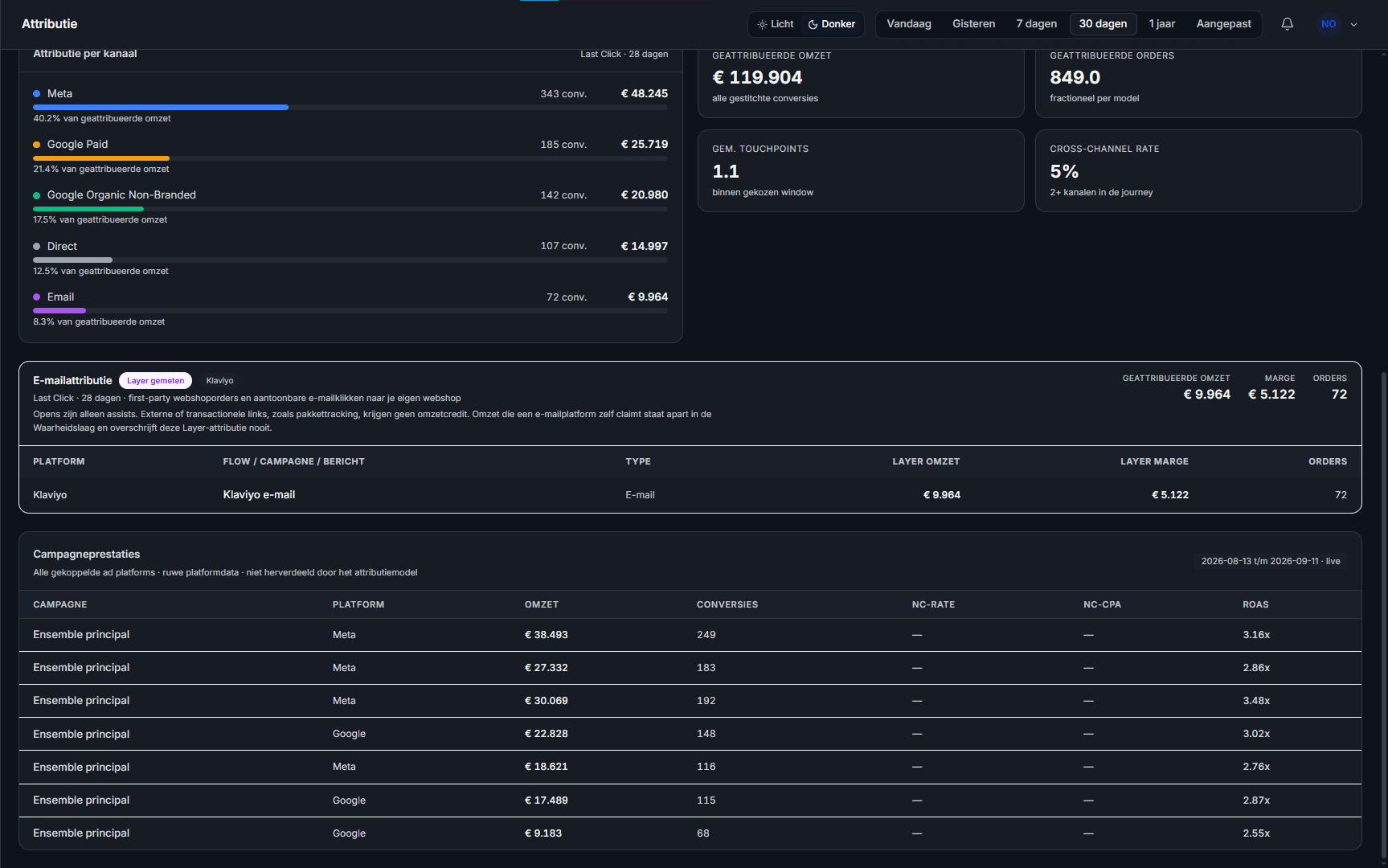
Do not scale because a platform attributes well to itself. Scale when the same order data shows that additional spend also creates additional contribution.
These are the questions you should answer in minutes.
Not another dashboard to stare at, but intelligence that supports a concrete budget decision.
Who really caused the sale?
See which touchpoints influenced the order without counting the same revenue multiple times.
How much revenue is claimed twice?
Compare platform claims with actual revenue and see where reporting overlaps.
Which channel deserves more budget?
Combine contribution with margin and costs so ROAS is not your only steering metric.
Bring together · Explain · Decide
Orders are the base. Then we connect touchpoints, reconcile claims and apply one consistent attribution logic.
Orders as the base
Your commerce platform establishes which orders and revenue actually exist.
Bring touchpoints together
Clicks, campaigns and journeys are attached to the same order.
Reconcile claims
We see where multiple channels claim the same revenue.
Choose a model and decide
Compare first touch, last click, linear, position based and time decay.
View the same revenue through multiple models.
No model is always perfect. See how the outcome changes when the logic changes.
| Model | When useful | What it prevents |
|---|---|---|
| First touch | Understand acquisition | Giving everything to the last click |
| Last click | Direct conversion impact | Losing sight of the closing touch |
| Linear | Distribute the full journey | Overvaluing one touchpoint |
| Position based | Weight start and finish more heavily | Overweighting the middle |
| Time decay | Value recent touches more | Overvaluing older touches |
Attribution only matters when it changes a decision.
See where budget, brand search and incrementality need attention.
Reallocate budget
Move spend to channels that remain strong after overlap and margin.
Understand brand search
See when branded search mostly captures demand created elsewhere.
Test incrementality
Flag channels where platform claim and real contribution diverge too far.
What you want to know before you start.
Can Meta and Google both be right?
Yes. Both can correctly claim the same order within their own attribution window. The problem starts when you add the claims as if they were two orders.
Do I need to pick one model?
No. Compare models on the same order data and see which decisions remain robust.
Go deeper on the decision logic.
Why your Meta ROAS is lying to you and how to measure what actually happened
Platform attribution models are built to make platforms look good. We analyzed 48 DTC brands over 90 days and found the average over-attribution gap is 34%. Here is what to do about it.
Spillover: when your Google ad gets credit for a Meta click
Cross-channel attribution overlap is silently inflating your numbers. We found that 87 percent of DTC brands we analyzed had significant spillover between at least two channels. Here is what it costs you and how to measure it.
The only attribution method that cannot lie: incrementality testing
Reported ROAS, last-click models, and even server-side attribution all measure correlation between ad exposure and purchase. Incrementality testing measures causation. Here is how to run it without a data science team.
See how much revenue is being claimed twice today.
Start with public signals. Then connect your own data for true channel contribution.