A channel can grow revenue while putting pressure on margin.
Feed quality, marketplace fees, advertising, fulfilment and product identifiers belong in one view. That is how you see which channel revenue truly contributes.
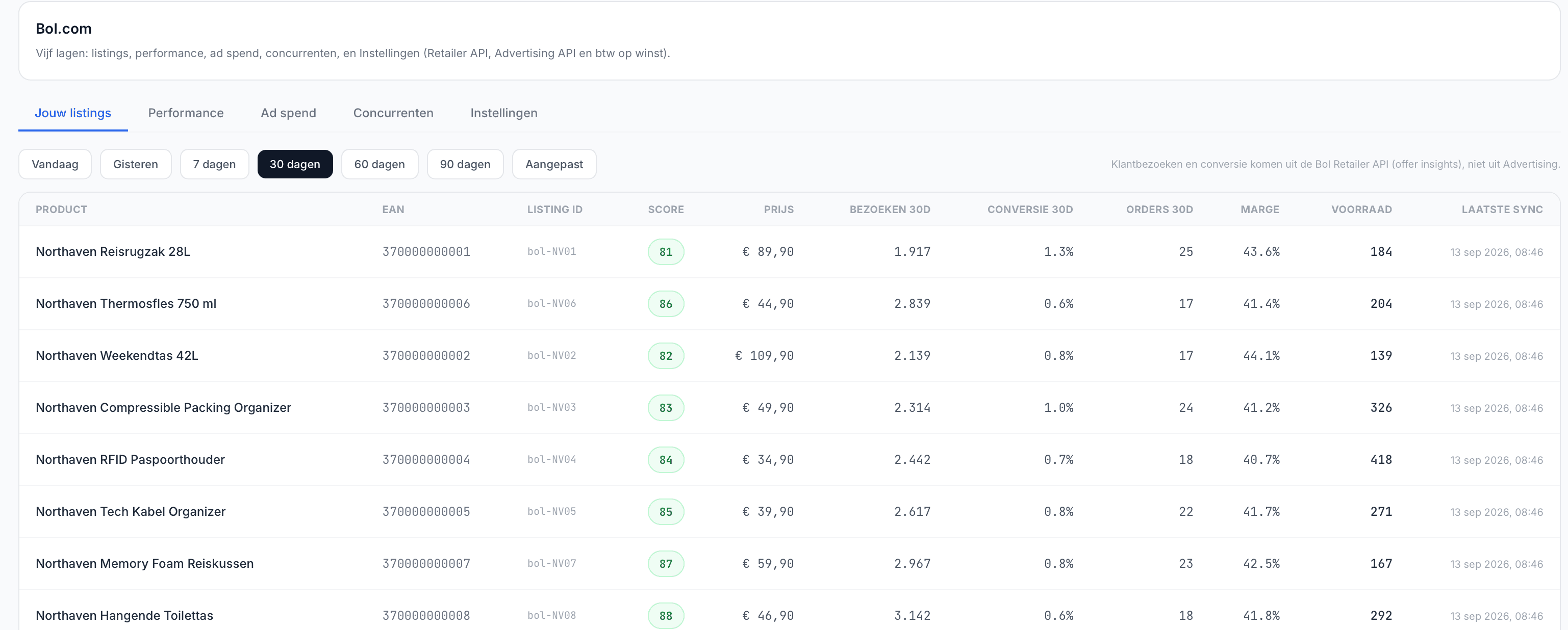
Marketplace orders have different fees, fulfilment and ad costs. They should be calculated separately while remaining comparable.
Which marketplace revenue is truly healthy?
Feeds determine visibility. Fees and fulfilment determine whether that visibility is economically valuable.
Which products have weak feed quality?
See title, identifiers, category and disapproval issues.
Which marketplace creates real contribution?
Put fees, ads and fulfilment next to order margin.
Is product mapping correct everywhere?
Map SKU, barcode and EAN across store and marketplaces.
Bring together · Explain · Decide
Website and marketplaces stay separate where economics differ and come together where product identity is the same.
Product identity
SKU, barcode and EAN connect the same product.
Feed quality
Rules, titles and missing fields are checked by channel.
Order economics
Fees, ad spend and fulfilment are added by order.
Compare
See where the same product performs differently by channel.
Compare channels without flattening their cost logic.
A marketplace order is not a website order. Economics stay separate and comparable.
| Channel | Unique costs | Key signal |
|---|---|---|
| Website | Payment, shipping, fulfilment | Direct customer relationship |
| Marketplace | Commission, labels, ads | Marketplace contribution |
| Amazon | Fees, fulfilment, ads | Net contribution |
| Google feed | Visibility impact | Feed health and demand |
Feeds and marketplaces become a commercial intelligence layer.
Not just checking whether products are live, but understanding what they contribute.
Feed fixes
Prioritize issues by revenue and demand impact.
Marketplace scale
Scale only where fees and ads leave healthy contribution.
Assortment
Determine which SKU fits each channel commercially.
What you want to know before you start.
Does the same SKU need the exact same identifier everywhere?
Ideally yes, but mapping needs to handle exceptions when platforms use different fields.
Can marketplace ads be combined with revenue?
Yes. Spend and attributed revenue belong next to organic marketplace revenue in one channel view.
Go deeper on the decision logic.
Google Shopping feed optimization: the work that pays more than any bidding change
Most DTC brands spend hours on Google Ads bidding strategies and minutes on their product feed. The return on that time allocation is backwards.
Contribution margin per channel: the number your agency will not show you
ROAS tells you revenue per euro spent. Contribution margin tells you profit per euro spent. They often point in opposite directions. Here is how to calculate the one that actually matters.
True landed cost: the COGS calculation most DTC brands get wrong
Your product cost is not just what you paid the factory. Every brand that underestimates COGS underestimates how much margin they are burning on growth.
See which channels buy revenue and which build value.
Connect marketplace orders, fees and product data to compare the same SKU fairly across channels.